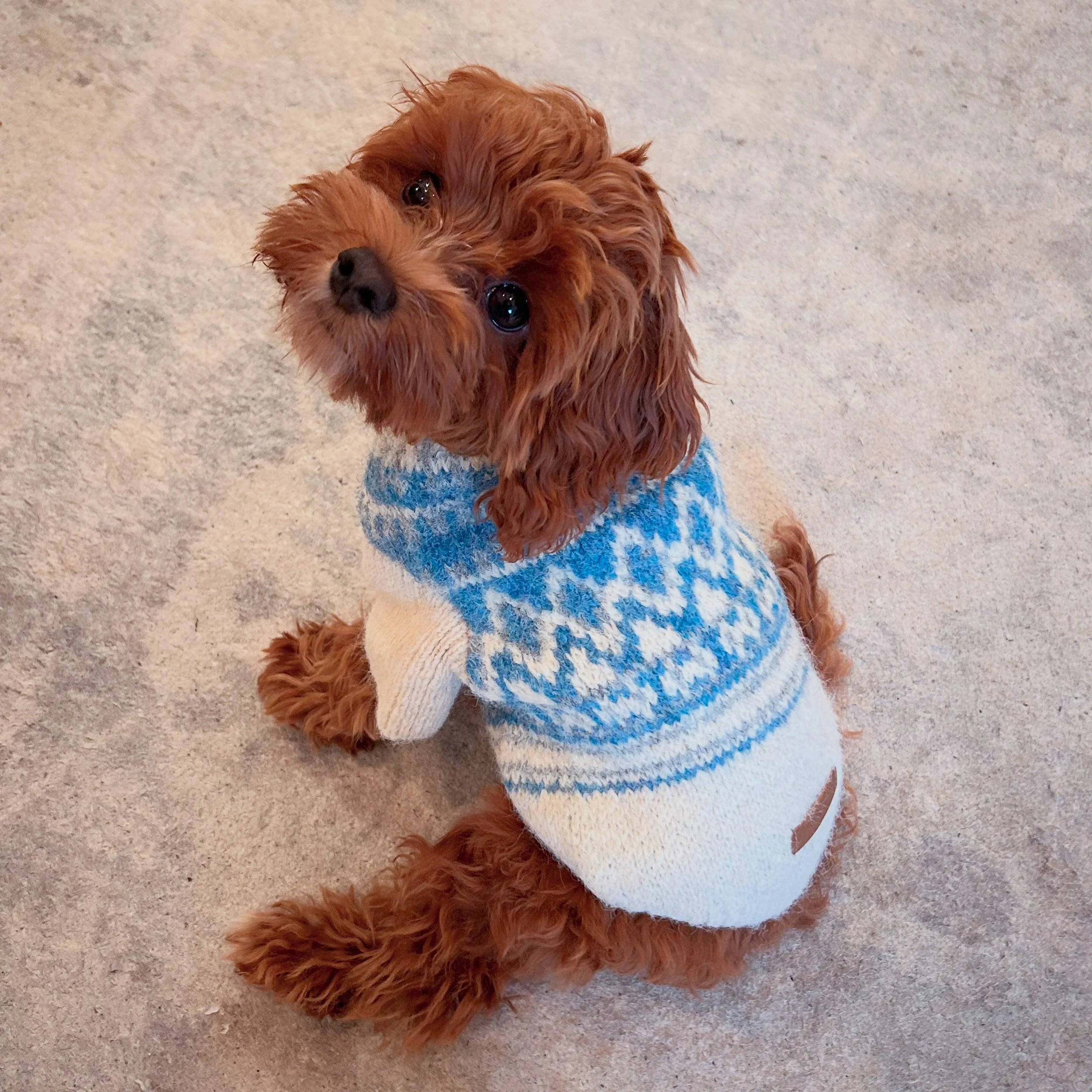
Theo’s Story
We found Theo through a breeder in Utah - an expensive, carefully chosen breeder, because we wanted to do everything right. His dad is a 3 lbs toy poodle. His mom a 14 lbs F1 Cavapoo. He was, by every measure, a perfect puppy. He came home to us at 9 weeks old. We drove five and a half hours to Seattle airport to collect him and five and a half hours back - eleven hours on the road for a puppy we had already fallen completely in love with before we even met him.
For months, he was exactly that. Perfect.
Then on December 22nd, 2025, after an ordinary day out at Granville Island buying ingredients for Christmas dinner, he started yelping when we went to touch him. It happened several times - enough to alarm us, though in between he seemed okay. We took him to the vet the next morning. They did a urine sample, told us he was perfectly fine, and sent us home to monitor him. As we walked out of the vet's office, a stranger reached down to pet him on the street. He yelped again.
That night he deteriorated rapidly. By 4am on Christmas Eve he was sitting rigid in his crate, shaking, and in obvious pain. We took him to emergency where the attending vet - who had seen this before in Cavapoos - referred us urgently to the only veterinary neurologist working in the city over the holidays - and we will forever be grateful that she was. We paid for a second emergency consult at another hospital before finally seeing her. She ordered an MRI and a spinal tap.
While we waited, we did what any terrified dog owner does - we searched frantically for anything that could explain what was happening to our puppy. What we found stopped us cold. Almost nothing. A few forum threads. A handful of fragmented articles. No clear information, no registry, no community of owners who had been through this that we could find easily. For a condition that - as we would later learn - affects dogs all over the world, the internet had almost nothing to offer us in our most desperate moment.
We didn't even know this disease existed before that night. It hadn't even crossed our regular vet's mind that morning - the one who had seen Theo just hours before and sent us home with a clean bill of health. How is it possible that a condition serious enough to send a seven and a half month old puppy into emergency on Christmas Eve is so unknown that even vets aren't recognising it? Why had we never heard of it? Why had no one we knew ever mentioned it? And why, when we searched desperately for answers, was there so little to find?
The diagnosis came: MUE - Meningoencephalitis of Unknown Etiology - combined with Chiari-like malformation. The neurologist was direct with us. This was one of the worst forms. Unlike SRMA, which is steroid responsive and carries a high recovery rate, MUE is unpredictable. She gave him a 50/50 chance of responding to treatment at all. Being as thorough as she was, she pointed us to the best research available - studies conducted on a very small number of dogs. That was the best data available for a condition affecting dogs worldwide.
We spent Christmas Eve in a waiting room not knowing if our seven and a half month old puppy would come home.
He did. And slowly, remarkably, he got better. Within days of starting prednisone we noticed more energy, more alertness, more of the puppy we knew. By mid-March - nearly three months after his diagnosis - he was walking for an hour and a half at a time. By June 2026 the hope is he will be fully weaned off steroids entirely.
His neurologist, who had been so measured with her prognosis on that first night, began to speak more hopefully. His recovery has exceeded what the statistics suggested was possible. But we live with uncertainty every day. We don't know if he will relapse. We don't know what the long term impact of this disease - and the treatment - will have on his body. We don't know what his future looks like, because there simply isn't enough data to tell us. No one can tell us. Simple decisions that most dog owners never think twice about - routine vaccinations, flea and tick treatments, even whether he will ever be strong enough to be neutered - are now conversations loaded with anxiety and uncertainty. There is no roadmap for us to follow. And that is something no family should have to sit with alone.
But here is what we keep coming back to: those statistics are based on almost nothing. A handful of studies. Tiny sample sizes. No centralised data. No registry. No way for the thousands of families who have been through this to contribute what they know to the collective understanding of this disease. And no way for the next terrified family to find the answers they desperately need when they need them most.
That is what The Theo Project is here to change.
Theo is currently doing well and continues to be closely monitored. He goes on long walks, plays like the 1 year old puppy he now is, and has no idea he started a movement. 🐾
*Theo's experience is unique to him. Treatment protocols, prognosis and outcomes vary significantly between individual dogs. Please consult a veterinary neurologist for advice specific to your dog.
*The Theo Project is a global registry for Meningoencephalomyelitis of Unknown Etiology (MUE) and other meningitis-related conditions, run by dog owners, not veterinary professionals. Nothing on this site constitutes medical advice.